How to Buy Contact Lenses without stressing you out starts with understanding what actually causes the stress. Most people think the challenge is choosing between dozens of brands and lens types.
The reality is, the biggest concern is making a costly mistake. Whether it’s ordering the wrong measurements, ending up with uncomfortable lenses, or paying more than necessary, the fear of getting it wrong is what makes the process feel overwhelming.
After years of seeing how people shop for contact lenses, one thing becomes clear: confident buyers don’t know everything about lenses. They simply know what questions to ask before making a decision.
Before you buy, consider these three questions:
- Will they fit properly? Check that your prescription, Base Curve (BC), and Diameter (DIA) match exactly.
- Will they feel comfortable? Consider the lens material, moisture retention, and how long you’ll wear them each day.
- Are they worth the cost? Look beyond the box price and factor in replacement schedules, shipping fees, and ongoing expenses.
These three questions will help you focus on what actually matters and avoid the mistakes that cause most contact lens frustration.

Why Buying Contact Lenses Feels More Stressful Than It Should
Think about it.
A shirt that doesn’t fit can be returned.
A gadget that disappoints can be resold.
Contact lenses sit directly on your eyes.
That changes the psychology of the purchase.
People worry about:
- Ordering the wrong prescription
- Choosing the wrong lens material
- Dryness after long workdays
- Hidden subscription charges
- Spending too much on a product they may dislike
The fear isn’t irrational.
The good news is that most problems can be avoided with a few simple checks.
Most contact lens mistakes happen before the box arrives.
Smart Check #1: Confirm Every Number on Your Prescription
This sounds obvious, but it’s where many mistakes begin.
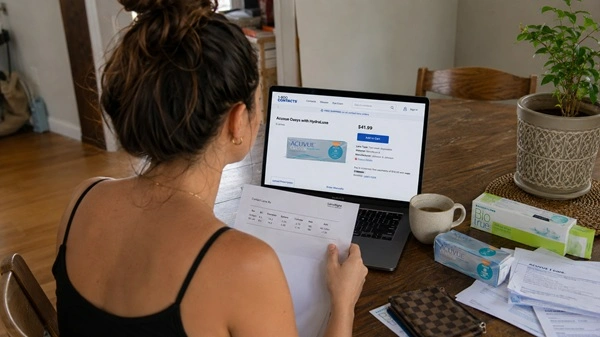
A contact lens prescription includes more than your vision correction.
Look closely at:
- Sphere (SPH)
- Cylinder (CYL), if applicable
- Axis, if applicable
- Base Curve (BC)
- Diameter (DIA)
Many shoppers focus only on the prescription power and ignore the fit measurements.
Your Base Curve (BC) affects how the lens sits on the eye.
Your Diameter (DIA) affects overall lens positioning and movement.
Even small differences can affect comfort.
Before clicking “Buy,” compare every value against your current prescription.
Smart Check #2: Understand the Lens Material
Not all lenses feel the same.
One of the biggest comfort factors is the material itself.
Many modern lenses use Silicone Hydrogel, which allows significantly more oxygen to reach the eye than traditional hydrogel materials.
This matters because oxygen flow affects long-term comfort.
Manufacturers often measure this through Oxygen Transmissibility (Dk/t).
Higher oxygen transmission generally helps reduce irritation during extended wear.
People who spend all day staring at screens often notice the difference.
Smart Check #3: Match the Lens to Your Lifestyle
A common mistake is buying based on price alone.
Instead, think about your actual routine.
Ask yourself:
- Do you wear lenses every day?
- Do you only use them for sports or events?
- Do your eyes feel dry after computer work?
- Do you travel frequently?
Someone wearing contacts once a week has different needs than someone wearing them twelve hours a day.
Lifestyle should guide the decision.
Not marketing.
The cheapest box isn’t always the cheapest choice over six months.
Smart Check #4: Pay Attention to Dryness Signals
Many people assume discomfort is normal.
It isn’t.
If your eyes often feel tired, gritty, or dry, look at factors that influence Tear Film Stability.
This is the thin layer of moisture that keeps the eye surface comfortable.
When the tear film breaks down too quickly, lenses can feel scratchy or irritating.
People who work under air conditioning, use multiple screens, or spend long hours indoors often experience this problem.
Choosing a lens designed for moisture retention can make a noticeable difference.
Smart Check #5: Know Your Replacement Schedule
Every lens has a recommended Replacement Schedule.
Common options include:
- Daily disposable
- Biweekly replacement
- Monthly replacement
Each has trade-offs.
Daily lenses are convenient and hygienic.
Monthly lenses may reduce long-term costs but require consistent cleaning and storage habits.
There is no universally best option.
The right choice depends on how disciplined you are with lens care.
Be honest with yourself.
Many people buy monthly lenses, intending to follow every rule and then forget halfway through the month.
Smart Check #6: Watch for Hidden Costs
A lower sticker price can be misleading.
Before buying, calculate:
- Cost per day of wear
- Shipping fees
- Auto-renewal charges
- Cleaning solution expenses
- Replacement frequency
I’ve seen shoppers save a few dollars on the box and spend far more through recurring charges they didn’t notice.
Read the checkout details carefully.
Especially subscription settings.
Smart Check #7: Think About Eye Health, Not Just Comfort
Comfort matters.
Eye health matters more.
Poor oxygen flow over time can contribute to Corneal Hypoxia, a condition where the cornea receives insufficient oxygen.
Most modern lenses are designed to minimize this risk, but material choice still matters.
This is another reason many eye care professionals prefer lenses with strong oxygen transmission characteristics.
A lens should feel good today and support healthy wear over the long term.
Comfort gets attention. Eye health earns consistency.
The Fastest Way to Make a Confident Purchase
If you’re standing on a product page, wondering whether to buy, stop and run through the 3-R Filter:
Right Fit
- Prescription verified
- BC verified
- DIA verified
Right Feel
- Suitable material
- Good moisture performance
- Appropriate for your daily routine
Right Cost
- Fair long-term value
- No hidden fees
- Replacement schedule fits your habits
If all three boxes are checked, you’re usually looking at a safe decision.
Your Next Step
Before ordering, pull out your current prescription and compare every specification line by line. Taking two extra minutes now can save weeks of discomfort, returns, and unnecessary expense later.
Final Thoughts
Buying contact lenses shouldn’t feel like a high-stakes decision, but for many people it does. That’s because the fear isn’t really about choosing a product. It’s about avoiding a mistake that affects your comfort, vision, and wallet all at once.
The simplest way to remove that stress is to stop chasing the “perfect” lens and start focusing on fit, comfort, and long-term value. When you use a structured process instead of guessing, the decision becomes much easier.
A small amount of caution before checkout is usually what prevents big frustrations afterward.
Put the L.E.N.S. Method™ Into Practice
Once you’ve identified your eye color, preferred look, and wearing habits, the next step is comparing lenses in real-world settings. Reviewing customer photos and everyday wear examples can give you a more accurate expectation of the final result than product images alone. You can check out Unicoeye’s “Still Eye-Catching” collection to see how different styles, colors, and patterns appear across a variety of eye colors and everyday looks.